We Analyzed Successful Teaching Podcast Names
Analyzing these podcast names, a few key trends emerge that could be helpful if you're considering launching your own teaching podcast. For instance, it's clear that descriptive, straightforward naming is often favored. 'The A&P Professor' and 'Music Studio Startup: Helping music teachers thrive as entrepreneurs' exemplify this strategy. They concisely reflect the content listeners can expect, using specificity to attract a target audience. While 'The A&P Professor' targets a niche scientific interest group, 'Music Studio Startup' targets those interested in merging teaching music and entrepreneurship. Another trend is the use of authoritative and emotional language. Podcast names like 'PREACH' and 'GIVE A HECK' use energetic verbs that evoke emotion and power, creating intrigue. Most notably, these strong, singular words are capitalized for emphasis, signaling conviction and intensity that aligns with the passionate nature of educators. Lastly, incorporating common phrases in the education realm resonates well with the target audience. 'Identity Talk for Educators LIVE' is an example of this tactic, weaving in the theme of identity, a relevant issue in today's diverse educational settings. In all, the naming patterns display a sensibility towards their audience's interests, combining descriptive language with emotional strength and relatable themes to attract and resonate with listeners.
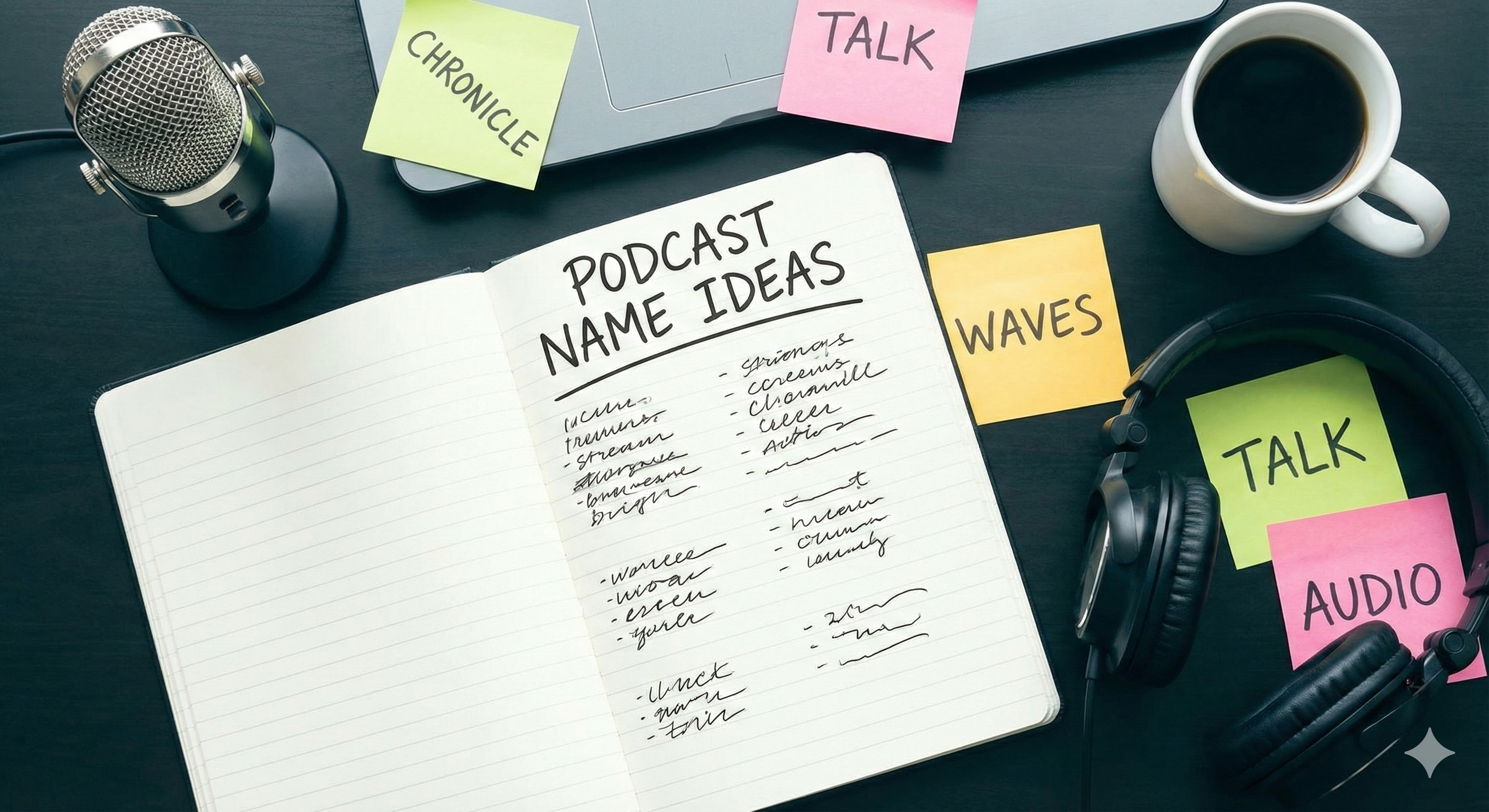
Tips for choosing a podcast name
- Descriptive: The name should give listeners an idea what your podcast is about.
- Short: 2 to 4 words (ideally up to 3) - still try to have it descriptive.
- Memorable: Your podcast name should be catchy, easy to say and easy to spell.
- Availability: Ensure it's available as a domain name (.com .fm are great domain extensions for podcast), on podcast directories and on social media platforms.
- Test it: Say the podcast name aloud, get feedback from people to see how it sounds, if they can guess what it's about.
Common podcast name mistakes
- Podcast name is taken: Using a taken name risks legal trouble, also unavailable domains and handles make branding much harder and could even end up with rebranding.
- Too vague or generic: A name like "Friends" is unlikely to stand out as it's not specific at all.
- Insider jargon: Don't use terms and words in the podcast name that only your immediate circle understands, it can prevent you from expanding your topic later.
- Adding "podcast" word: including the word "podcast" takes up valuable space (see Tip #2), choose another word for more descriptive keywords and stronger podcast name.
- Already taken or very similar to existing podcast: This is a major issue that could cause audience confusion and legal issues. Search for podcasts on platforms Apple Podcasts, Spotify and Podchaser
Podcast Name Generators
There are many free podcast name generators, but you shouldn't rely on them 100%. Most of such tools are just "wrappers" for basic AI (for example ChatGPT), it works very straightforward: simply takes your description and asks ChatGPT to "make a list of names." You could do that yourself directly on ChatGPT! The problem is that suggestions you get are often random and generic variants, so the hard work is left to you. You need manually checking for trademarks, available websites, and social handles to avoid the legal issues mentioned above.
That is why we built a different AI podcast name generator. Our generator isn't wrapping basic AI, it has been trained on database with more than 200,000 successful, active podcasts. It understands what makes a podcast name stick and it doesn’t just give you a name - it runs an initial analysis on SEO and availability right away, saving you from spending time on potential podcast names you can't actually use.
Real Teaching Podcast Names
-
The A&P Professor
Explore human anatomy and physiology (A&P) teaching and lear...
Founded: 2018Episodes: 196 -
Music Studio Startup: Helping music teachers thrive as entrepreneurs
The podcast about all things business for music teachers and...
Founded: 2018Episodes: 250 -
PREACH
These are talks given at services, conferences and events I'...
Founded: 2023Episodes: 62 -
Identity Talk 4 Educators LIVE
The "Identity Talk 4 Educators LIVE" Podcast highlights the ...
Founded: 2020Episodes: 232 -
GIVE A HECK
In the last 20 years, I have lived a life like many, by acci...
Founded: 2020Episodes: 274
Frequently Asked Questions About Naming a Podcast
While ChatGPT is a great brainstorming buddy, it has a major blind spot: it doesn't know what is currently available. It will happily suggest a perfect name like "The Daily Grind," unaware that there are already 15 podcasts, a coffee shop chain, and a trademark holder with that exact name. Using a standard AI "wrapper" forces you to manually fact-check every single suggestion. Our tool differs because it is trained on 200,000+ active podcasts and performs immediate availability checks, filtering out the "noise" so you don't waste time on taken names.
Yes, but be careful. Including a keyword (like "Marketing," "True Crime," or "Vegan") helps listeners find you when they search for a topic. However, Apple Podcasts creates issues for titles that look like spam.
- Good: "The Digital Marketing Masterclass"
- xBad: "Marketing | SEO | Social Media | Business Tips 101"
Aim for a natural title where the keyword fits legally and grammatically.
This is a risky move. Even if you don't plan to build a website immediately, not owning the domain makes it much harder to build a brand later. If the .com is taken by a similar business, you will confuse your audience.
Pro Tip: If the exact domain is expensive or parked, try adding "pod" or "show" to the URL (e.g., marketingmasterclasspod.com). If an active business already owns the main domain, it is usually safer to pick a different name entirely.
Checking podcast apps (Apple/Spotify) is not enough. A name might not be a podcast yet, but it could be a registered brand that can legally force you to take your show down.
- Search Google: Look for businesses using the name.
- Search Social Media: Check Instagram, TikTok, and X handles.
- Search Databases: Use the USPTO (for US) or WIPO (Global) trademark database searches. Our advanced generator runs initial checks to flag potential conflicts, but for total peace of mind, always do a final legal check before spending money on artwork.
Short and punchy is best. Aim for 29 characters or less. Why? Because on most podcast apps, titles longer than that get cut off with ellipses (...) on mobile screens. If your distinguishing word is at the end of a long sentence, potential listeners scrolling through their phone won't see it.
Technically, yes—you can change the text in your RSS feed, and it will update on Spotify and Apple. However, you will lose brand recognition. Listeners might unsubscribe if they don't recognize the new name, and you will have to rebuild your SEO ranking from scratch. It is much better to spend the extra time now to find a name you can grow with for years.
While ChatGPT is a great brainstorming buddy, it has a major blind spot: it doesn't know what is currently available. It will happily suggest a perfect name like "The Daily Grind," unaware that there are already 15 podcasts, a coffee shop chain, and a trademark holder with that exact name. Using a standard AI "wrapper" forces you to manually fact-check every single suggestion. Our tool differs because it is trained on 200,000+ active podcasts and performs immediate availability checks, filtering out the "noise" so you don't waste time on taken names.
Yes, but be careful. Including a keyword (like "Marketing," "True Crime," or "Vegan") helps listeners find you when they search for a topic. However, Apple Podcasts creates issues for titles that look like spam.
- Good: "The Digital Marketing Masterclass"
- xBad: "Marketing | SEO | Social Media | Business Tips 101"
Aim for a natural title where the keyword fits legally and grammatically.
This is a risky move. Even if you don't plan to build a website immediately, not owning the domain makes it much harder to build a brand later. If the .com is taken by a similar business, you will confuse your audience.
Pro Tip: If the exact domain is expensive or parked, try adding "pod" or "show" to the URL (e.g., marketingmasterclasspod.com). If an active business already owns the main domain, it is usually safer to pick a different name entirely.
Checking podcast apps (Apple/Spotify) is not enough. A name might not be a podcast yet, but it could be a registered brand that can legally force you to take your show down.
- Search Google: Look for businesses using the name.
- Search Social Media: Check Instagram, TikTok, and X handles.
- Search Databases: Use the USPTO (for US) or WIPO (Global) trademark database searches. Our advanced generator runs initial checks to flag potential conflicts, but for total peace of mind, always do a final legal check before spending money on artwork.
Short and punchy is best. Aim for 29 characters or less. Why? Because on most podcast apps, titles longer than that get cut off with ellipses (...) on mobile screens. If your distinguishing word is at the end of a long sentence, potential listeners scrolling through their phone won't see it.
Technically, yes—you can change the text in your RSS feed, and it will update on Spotify and Apple. However, you will lose brand recognition. Listeners might unsubscribe if they don't recognize the new name, and you will have to rebuild your SEO ranking from scratch. It is much better to spend the extra time now to find a name you can grow with for years.